
Key Takeaways
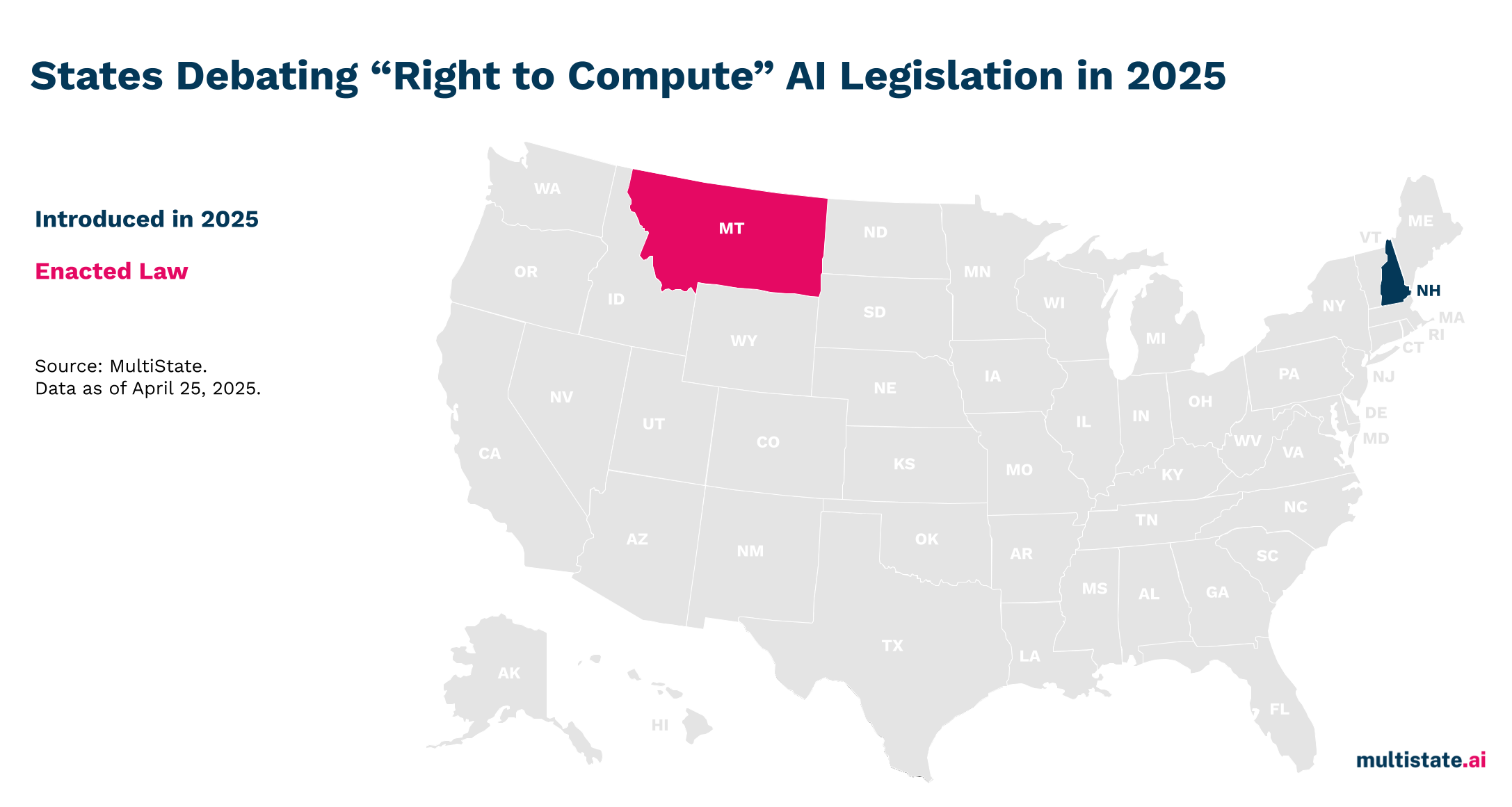
Montana became the first state to enact a right to compute law when Governor Gianforte signed Montana SB 212 in April 2025, establishing a fundamental right to privately own and use computational resources for lawful purposes.
The Montana right to compute law applies strict scrutiny, the highest constitutional standard, to any government restrictions on computational resources, making it very difficult for regulators to limit AI development or use.
While the law protects broad computing rights, it includes targeted critical infrastructure AI requirements that mandate risk management policies when AI systems make consequential decisions at facilities like power plants and water systems.
The passage of right to compute legislation in Montana reflects growing state AI regulation pushback, particularly in red states, as broader AI safety bills have struggled to gain traction this year.
If you're a subscriber, click here for the full edition of this update. Or, click here to learn more about our MultiState.ai+ subscription.
Over the past month or so, we've chronicled the deceleration of the regulatory movement that had high hopes at the beginning of the year to enact AI consumer protection and safety legislation at the state level. The fear of geopolitical competition, especially after the hype around the Chinese DeepSeek model, along with a major policy shift on the federal level under President Trump, has changed the narrative in the states, which were already facing skepticism from governors. But there's also a small movement in the states to flip the script on AI regulation by enacting a "right to compute." Last week, Montana became the first state to enact such a bill into law.
Montana Leads Right To Compute Movement
Montana lawmakers, who are only in session for a short period every two years, made up for lost time this year by introducing 48 AI-related bills. Two have been signed into law, and another six bills have passed the legislature and are awaiting the governor's signature to become law. Two additional bills have passed their chamber of origin and await further action before the legislature is scheduled to adjourn for the year on May 3.
Montana's "Right to Compute Act" was introduced by Senator Daniel Zolnikov (R), who previously backed the state's data privacy law as well as pro-cryptocurrency laws. Gov. Gianforte (R) signed the "Right to Compute Act" into law on April 16, 2025. This wasn't Sen. Zolnikov's first foray into the right to compute debate. In 2023, Sen. Zolnikov passed the country's first right-to-mine law (MT SB 178), which gave Bitcoin miners the right to mine "without being subjected to undue discrimination or requirements."
Understanding Montana's Right To Compute Act
Strict Scrutiny Standard For Government Restrictions
Sen. Zolnikov's "Right to Compute Act" (MT SB 212) is broader than crypto. It establishes a fundamental right to privately own and use computational resources for lawful purposes in Montana. Under the law, any government restriction on computational resources must be narrowly tailored to fulfill a compelling government interest. This is known as a "strict scrutiny" standard under constitutional law, which is the highest standard of review that courts use to evaluate the constitutionality of governmental laws. Strict scrutiny is generally reserved for our most fundamental rights, such as the freedom of speech under the First Amendment. This standard places the burden of proof on the government and is very difficult to satisfy.
Critical Infrastructure Safety Requirements
However, the law does contain some restrictions on AI use. Particularly, the bill contains a provision for when "critical infrastructure facilities are controlled in whole or in part by a critical artificial intelligence system." In that specific instance, the deployer must develop a risk management policy. But what's a "critical infrastructure facility"? The bill points to a definition in current Montana statutes that lists 22 categories of critical infrastructure facilities, including power plants, water systems, telecommunications networks, and major industrial manufacturing facilities.
However, this risk management policy requirement will only trigger if one of those facilities are controlled (in whole or in part) by a "critical artificial intelligence system," which is defined as an AI system "designed and deployed to make, or is a substantial factor in making, a consequential decision." The definition doesn't further define consequential decisions, but it does include a list of exceptions, eliminating many more routine AI tasks. Overall, especially when compared to the broad scope of the algorithmic discrimination bills, this is a pretty narrow safety requirement limited to situations where an AI system is making critical decisions at a facility that is vital to the public interests.
Legislative Changes During Passage
Notably, the version of the bill originally introduced in the Montana Legislature contained a requirement that critical infrastructure be able to perform a full shutdown of the AI system. The legislation was later amended to remove the requirement that a deployer of AI at a critical infrastructure facility must have the "capability to disable the artificial intelligence system's control over the infrastructure and revert to human control within a reasonable amount of time." This softened the regulations on critical artificial intelligence systems from a shutdown action to only the risk management policy requirement that appears in the enacted version.
National Right To Compute Movement And Political Divide
The "right to compute" idea has been enthusiastically backed by proponents of a light regulatory touch for AI. "Most states are going in the wrong direction because of fear-mongering," Sen. Zolnikov told Pluribus News. "All it does is make it unfair to business." A bill (AZ HB 2342) aimed more at the crypto mining community (but also applying to AI compute) was signed into law last week, but it's limited to prohibiting local government from restricting an individual using computational power at their residence.
While the only other explicit "right to compute" proposal, New Hampshire's proposed constitutional amendment (NH CACR 6), hasn't gained the same traction, legislation restricting government use of AI is increasingly popular. And more importantly, the movement to broadly regulate AI this year has failed to accomplish major wins so far. This has all the hallmarks of becoming a major philosophical divide between blue and red states.
If you're a subscriber, click here for the full edition of this update. Or, click here to learn more about our MultiState.ai+ subscription.

