
Key Takeaways
- California's SB 53 requires developers of the largest AI models to adopt safety policies, implement safeguards against dangerous capabilities, and designate a safety officer. Unlike its predecessor SB 1047, the law applies only to models costing at least $100 million to train.
- California also finalized two sets of AI regulations in 2025: the CPPA's automated decision-making technology rules under the CCPA, and first-in-the-nation AI employment discrimination regulations from the Civil Rights Council. Both impose new notice and compliance obligations on businesses operating in the state.
- The No Robo Bosses Act (SB 7) requires employers using AI for consequential employment decisions to provide written notice and ensure a human reviews any discipline or termination decision. Employers cannot rely solely on AI to terminate or deactivate a worker, and the law covers both employees and independent contractors.
- Gov. Newsom vetoed AB 1018, the algorithmic discrimination bill, citing overly broad definitions, litigation risk from its private right of action, and overlap with the ADMT regulations already in place.
- All 50 states now have laws or active proposals addressing sexual deepfakes, with 20 states having enacted laws that specifically criminalize AI-generated non-consensual intimate imagery. The trend across states is largely to expand existing non-consensual intimate image laws to cover AI-generated content.
- If you're a subscriber, click here for the full edition of this update. Or, click here to learn more about our MultiState.ai+ subscription.
California has long been a national leader in technology policy, and that continued in 2025, particularly in artificial intelligence legislation. The California State Legislature considered 48 AI-related bills this year, ultimately approving several significant measures. The headline of this year's enactments is Sen. Scott Wiener's (D) high-profile AI safety bill (CA SB 53), signed into law by Gov. Gavin Newsom (D) in September. Additionally, the California Privacy Protection Agency finalized regulations for automated decision-making technology (ADMT) and the California Civil Rights Council finalized AI employment discrimination regulations.
California AI Safety Legislation for Frontier Models
We've followed the progress of Sen. Wiener's AI safety bill closely this year. SB 53 requires all developers of large AI models (called "frontier models") to develop an AI safety policy, implement reasonable safeguards against dangerous AI capabilities, and designate a safety officer. The law also requires developers to provide annual updates on these policies.
In a significant improvement from the previous year's iteration, SB 1047, the new law is focused on only the largest AI models, specifically those that cost at least $100 million to train. This is meant to capture only the largest "frontier" models, which are the models that state and federal lawmakers are most worried about when it comes to potential existential risks of AI.
California Privacy and Consumer Protection AI Regulations
In September, the California Privacy Protection Agency (CPPA) also finalized its automated decision-making technology (ADMT) regulations under the California Consumer Privacy Act (CCPA). These regulations broadly mirror what consumer-facing AI bills have tried to accomplish at the state legislative level.
For example, these regulations require businesses that use automated decision-making technology to provide consumers with notices both before collecting their personal information and at the point of using ADMT to make "significant" decisions about them. These regulations define a "significant decision" to include the provision or denial of financial or lending services, housing, education enrollment or opportunities, employment or independent contracting opportunities or compensation, or healthcare services.
Consumers also have the right to opt out of having their personal information processed for the purposes of using ADMT to make these significant decisions about them, as well as the right to a human review of the significant decision made by the ADMT.
The ADMT regulations present potential compliance complexities for businesses operating in California, as they work in parallel with the consumer AI transparency and protection bills passed in the legislature. For businesses that use automated technology to make "significant" decisions about California consumers, these regulations will require material changes to their data processing practices.
California AI Employment Regulations and Requirements
Civil Rights Council AI Employment Discrimination Rules
This year also saw California finalize first-in-the-nation AI employment discrimination regulations through the California Civil Rights Council (CCRC). These regulations took effect in October.
These regulations broadly prohibit employers and labor organizations from using AI selection procedures or automated-decision systems to discriminate against employees and applicants based on a protected characteristic. They also require employers who use AI in employment decisions to provide candidates with notice. Notably, the regulations not only prohibit intentional discriminatory uses of AI, but also prohibit using AI in employment decisions that creates a statistically significant adverse impact on a protected class.
These regulations apply to both the employers making employment decisions and any vendors that sell them AI systems. For employers selling AI tools for employment decisions in California, these regulations impose significant obligations — particularly around auditing the models for potential adverse impact and notice requirements.
No Robo Bosses Act Requirements for Employers
Gov. Newsom also signed CA SB 7, the No Robo Bosses Act, into law. We previously discussed the bill as it sat on the governor's desk. The new law requires any employer using AI to make "consequential employment decisions" to provide written notice to employees or applicants and to conduct a human review of decisions involving discipline or termination. The law also prohibits an employer from relying solely on AI to make the termination or deactivation decision. These obligations apply to both traditional employees and independent contractors, taking effect January 1, 2027.
Governor Newsom Vetoes Algorithmic Discrimination Bill
Conspicuously absent from the above is CA AB 1018, the algorithmic discrimination bill we discussed as part of California's AI bills this session. Indeed, Gov. Newsom vetoed the bill. In his veto message, the governor cited overly broad definitions of consequential decisions and automated decision systems, the potential for increased litigation from its private right of action, and the redundancy with the ADMT regulations.
Nationwide Sexual Deepfake Legislation and Enforcement
Beyond California, this newsletter includes a chart tracking legislative action on sexual deepfakes across the country, which is becoming one of the most common forms of technology-facilitated sexual abuse. This is a chart showing which states have laws and proposals on this topic.
In all 50 states, there are laws or active proposals to regulate or criminalize various forms of sexual deepfakes, including non-consensual intimate imagery (NCII). At the federal level, the DEFIANCE Act was signed into law last year, creating a federal civil right of action for victims of sexual deepfakes. Forty-four states have enacted a criminal penalty for sharing non-consensual intimate images. And a growing number of states are now pursuing laws specifically addressing AI-generated sexual deepfakes.
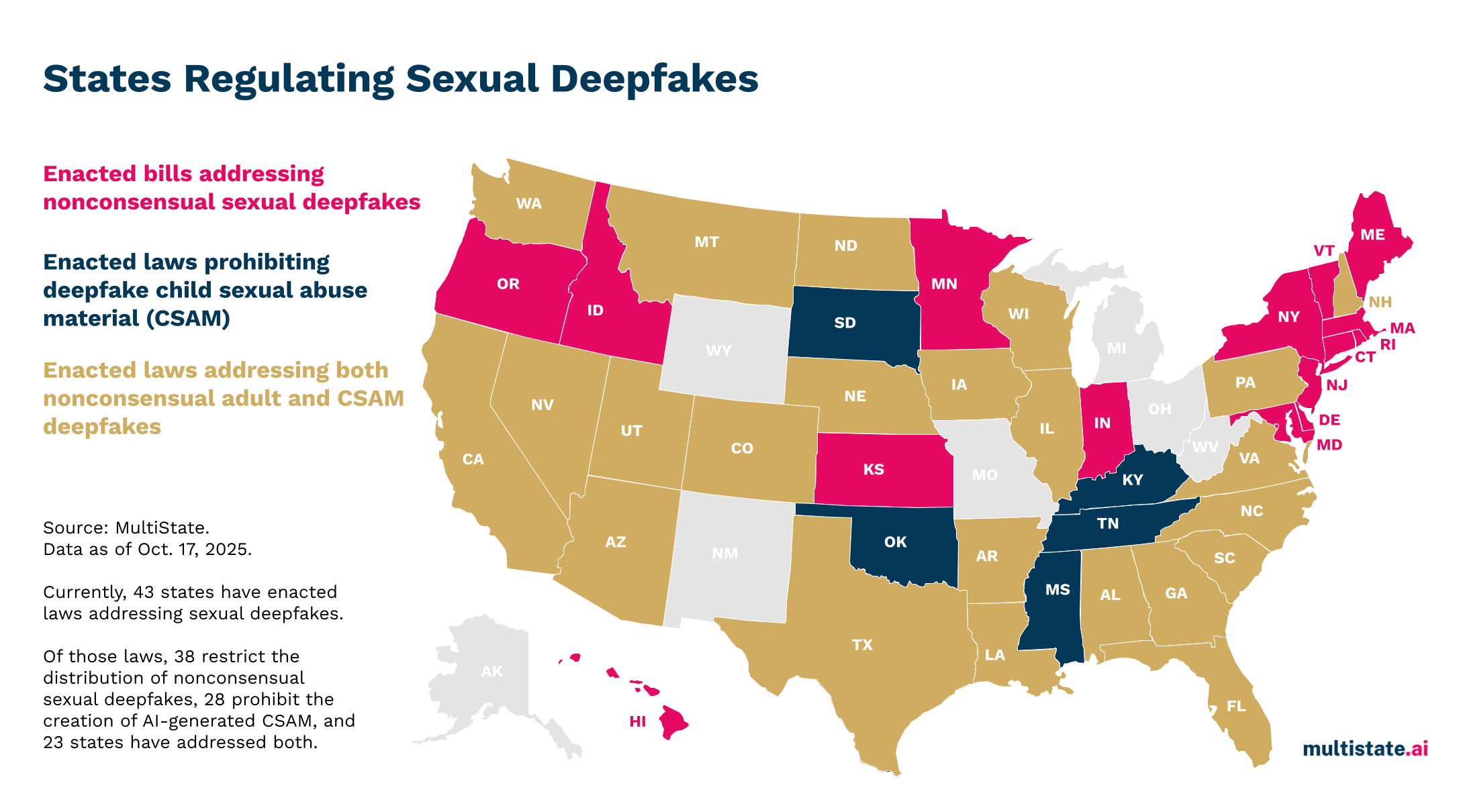
To date, 20 states have enacted laws specifically criminalizing sexual deepfakes (sometimes referred to as NCII using AI, or NCIA). And at least 39 states have active bills proposing to either enact or strengthen their NCII or NCIA laws. With 44 states having criminal NCII laws and 20 states with criminal NCIA laws, the most common new proposals across states are to expand existing laws to include AI-generated imagery. California enacted two such bills this year (CA AB 1040 and CA AB 1018), and several states specifically prohibit the use of AI in generating such images (SD SB 130, WY HB 60).
If you're a subscriber, click here for the full edition of this update. Or, click here to learn more about our MultiState.ai+ subscription.