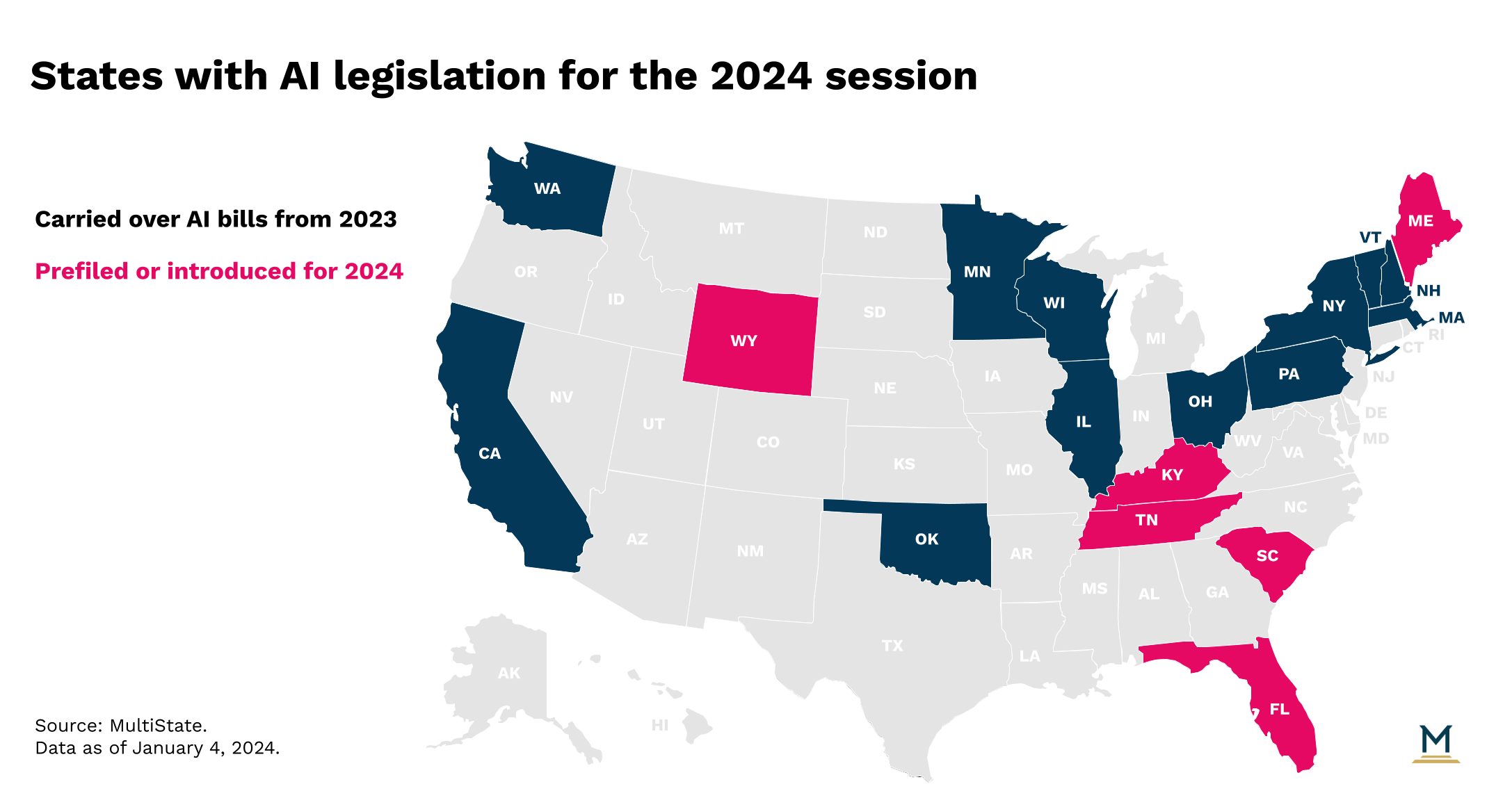
Key Takeaways
State AI policy 2024 will see both comprehensive and narrow regulatory approaches, with Democratic-led states like Connecticut, California, and New York pursuing broad frameworks while Republican lawmakers favor targeted solutions for specific industries.
AI disclosure requirements states are considering would mandate labels on AI-generated content and require opt-out options for AI-assisted services, particularly in healthcare.
Algorithmic discrimination regulation is emerging as a priority, with proposed AI legislation state bills requiring impact assessments to prevent biased algorithms from amplifying discrimination in housing, employment, and insurance.
Deepfake laws election year will expand beyond the five states that already regulate political deepfakes, with lawmakers responding to concerns about misinformation and non-consensual sexual deepfakes in schools.
States are balancing protective measures with innovation incentives, proposing workforce development programs and new agencies to attract AI companies while preparing citizens for the technology's impact.
If you're a subscriber, click here for the full edition of this update. Or, click here to learn more about our MultiState.ai+ subscription.
The arrival of generative AI tools last year brought incredible possibilities but it also raised concerns about the potential impact of the new technology. The public and experts think regulations will be necessary. And policymakers have vowed to take quick regulatory action to ensure they will not fall behind the rapidly accelerating technology as they did with data privacy regulation. What can we expect from state AI policy in 2024?
State Lawmakers Pursue Balanced Approach To AI Regulation
Last fall, state lawmakers around the country met in working groups to educate themselves on AI and its potential impacts. Repeatedly, they stressed providing "broad guardrails" but with a "light touch," emphasizing the need to impose rules to prevent harmful impacts from AI without smothering the nascent industry in its infancy. Connecticut Senator James Maroney (D), who chaired a working group in his home state and organized a multi-state group of lawmakers to study AI, has discussed the delicate balance lawmakers hope to take, saying, "We don't want to hamper innovation, but we also want to make sure we're protecting the rights of our constituents."
Comprehensive Vs Narrow Regulatory Approaches By State
Sen. Maroney intends to introduce a comprehensive AI bill in Connecticut this year. We expect a handful of additional states (e.g., California, Colorado, and New York) to take the same approach. Note that the states expected to debate a broad, comprehensive approach to AI regulation are all blue states with Democratic trifectas. But AI regulation will be a bipartisan endeavor this year, with Republicans more likely to support a narrower approach, addressing specific issues of concern or particular industries.
Consumer Disclosure Requirements For AI-Generated Content
One way of taking a narrow approach with a "light touch" would be to allow AI development and deployment to proceed but require disclosures to consumers. Content generated with AI assistance may require a label informing consumers about that fact. This could apply to newspaper articles or books, as two bills introduced in New York (NY AB 8158 and NY AB 8098) proposed to do, or any AI-generated content more generally as a Pennsylvania bill (PA HB 1598) would require. When it comes to AI-assisted services, particularly in the health care sector, expect lawmakers to propose disclosure requirements and a means to opt out, as bills regulating AI-assisted health services in Illinois (IL HB 1002) and Massachusetts (MA HB 1974) would require.
Key Areas Of AI Policy Focus In 2024
Preventing Algorithmic Bias And Discrimination
Policymakers are concerned that AI models, trained on biased data, could amplify discrimination against certain protected classes. A proposed bill in California (CA AB 331) would require impact assessments to ensure algorithms do not have a disparate impact on certain populations. Other bills focus on potential algorithmic discrimination in certain fields, like legislation in New York on housing (NY AB 7906), employment (NY SB 5641), or insurance (NY AB 8369).
Regulating Deepfake Technology And Misinformation
The proliferation of AI-generated "deepfake" media will be an immediate concern, particularly political deepfakes in an election year where misinformation could flourish. Michigan became the fifth state to enact laws regulating the use of political deepfakes last fall. Non-consensual sexual deepfakes in high schools have made recent headlines, which should spur lawmakers into action. Nine states have already enacted laws covering sexual deepfakes, with more likely to join that list this year.
Expanding Facial Recognition Oversight To Private Sector
So far, most facial recognition regulation has focused on government use of the technology, particularly law enforcement. But with the FTC cracking down on retail use of facial recognition technology, we could see state lawmakers start to target the private sector. A New York bill (NY AB 8129) purporting to be an "Artificial Intelligence Bill of Rights" would prohibit continuous surveillance in education, work, or housing.
States Embrace AI Innovation And Workforce Development
Finally, look for lawmakers to embrace the positive impacts of artificial intelligence. Policymakers want to attract AI companies to their state. A New York bill (NY AB 7501) would create a new agency on algorithmic innovation. Lawmakers will also want to ensure the workforce is prepared for the challenges AI could bring by enhancing workforce development and education. A bill introduced in Kentucky this week (KY SB 52) would require AI to be integrated into the educational curriculum.
As the transformative potential of AI unfolds across various sectors, the regulatory landscape is poised for significant developments in 2024. Policymakers, cognizant of the delicate balance between fostering innovation and safeguarding constituents' rights, are approaching AI legislation with a nuanced perspective. The coming year will bring the first seeds of AI policy, reflecting both the concerns and opportunities presented by this rapidly advancing technology.
If you're a subscriber, click here for the full edition of this update. Or, click here to learn more about our MultiState.ai+ subscription.