
Surveillance Pricing Laws: How New York and California Are Regulating Algorithmic Price-Setting
Key Takeaways
New York and California both passed surveillance pricing laws this year, marking a shift toward direct state regulation of how algorithms use personal data to set prices for individual consumers.
New York's law requires businesses to display a clear notice when a price is generated by an algorithm using a consumer's personal data. A federal judge upheld the disclosure requirement after industry groups challenged it on First Amendment grounds.
California took a different approach, amending its antitrust law to ban the use of common pricing algorithms in anticompetitive agreements, targeting systems where two or more firms share competitor data to influence prices.
Algorithmic rent-setting has drawn its own wave of legislative attention. Washington became the first state to ban landlords from using algorithmic tools that rely on nonpublic competitor data to set or recommend rental prices, and more states are expected to follow in 2026.
Florida's governor proposed an "AI Bill of Rights" built around five consumer protection principles, including protections against algorithmic discrimination and AI surveillance. If legislation follows in 2026, it could offer a new model for states looking to regulate AI outside the California framework.
If you're a subscriber, click here for the full edition of this update. Or, click here to learn more about our MultiState.ai+ subscription.
State lawmakers are beginning to confront one of the most immediate ways artificial intelligence is reshaping daily economic life. Retailers, landlords, and online platforms increasingly rely on algorithms to tailor prices to individual consumers. This raises questions about fairness, transparency, and the use of personal data. States have begun to test how far they can go in policing the algorithms that set what people pay, but they are also grappling with how to preserve the efficiency, accuracy, and competitive benefits these tools can provide when used responsibly. New York and California enacted new "surveillance pricing" laws this year.
How Algorithmic Pricing Evolved from Dynamic to Personalized
Merchants setting individualized prices for a particular customer is not necessarily a new practice. Airlines used dynamic pricing in the 1980s, and e-commerce platforms adopted similar techniques in the 2000s, as they began incorporating customer data into pricing decisions. As retailers gathered more behavioral and demographic information, dynamic pricing developed into individualized pricing, where algorithms estimate how much a specific person might be willing to pay. Today, companies can adjust prices based on browsing history or device type, which can serve as a proxy for purchasing power, or inferred urgency, sometimes layering in competitor data or neighborhood-level location information to shape what each consumer sees.
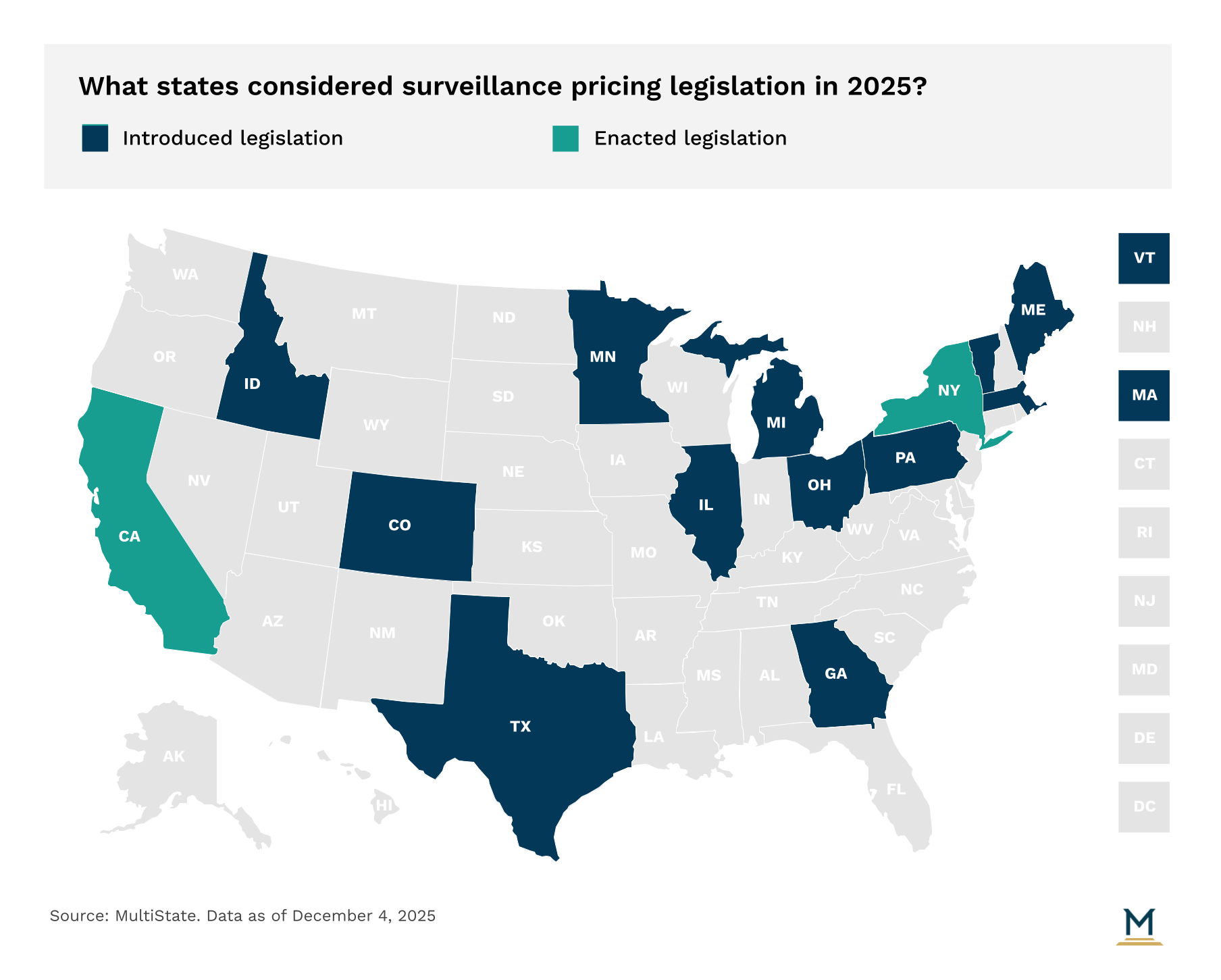
That capability has drawn scrutiny from lawmakers who worry about inadvertent discrimination, algorithmic manipulation, and protecting consumer privacy. Lawmakers in thirteen states introduced bills this year to regulate "surveillance pricing," with new laws passed in California and New York. The Federal Trade Commission (FTC) also conducted an inquiry into surveillance pricing practices earlier this year (before President Trump was sworn in), with then-chair Lina Khan concluding that "the FTC should continue to investigate surveillance pricing practices because Americans deserve to know how their private data is being used to set the prices they pay and whether firms are charging different people different prices for the same good or service." However, under the leadership of Trump-appointed FTC chair Andrew Ferguson, the agency closed down a request for public comment on the issue.
New York and California Enact Surveillance Pricing Laws
New York Requires Disclosure When Algorithms Use Personal Data
New York's new surveillance pricing law took effect last month on November 10 following a consumer alert from Attorney General Letitia James (D). The measure, which was included and passed in the budget bill back in the spring (NY A 3008/S 3008) requires any business that advertises or displays a dynamic price generated by an algorithm using a consumer's personal data to include a clear notice stating: "THIS PRICE WAS SET BY AN ALGORITHM USING YOUR PERSONAL DATA." It is important to note that this would not apply to all dynamic pricing models, only those that use the personal data of a customer. The law defines personal data as "any data that identifies or could reasonably be linked, directly or indirectly, with a specific consumer or device," although location information used by ride-sharing services for fares based on mileage and duration is exempted. The law also exempts regulated financial institutions and entities regulated by insurance laws, as well as prices offered to consumers with subscription-based contracts. The attorney general is responsible for enforcing the law and is granted the authority to investigate complaints, issue cease-and-desist letters, and seek injunctions and civil penalties of up to $1,000 per violation.
Industry groups challenged the law in court, arguing that the required disclosure forces retailers to criticize their own pro-consumer pricing practices and therefore violates the First Amendment. A U.S. District Judge dismissed the suit, holding that compelled commercial disclosures are constitutional if not unduly burdensome and reasonably related to the state's interest in preventing consumer deception.
California Targets Anticompetitive Pricing Algorithms
California lawmakers considered stronger surveillance pricing measures this summer, including a bill that would have prohibited any pricing algorithm that included competitor data (CA SB 295). Another bill would have prohibited a price offered online from being generated based on data such as the hardware state of the online device, the presence or absence of any software, or geolocation data (CA SB 259). Ultimately, Gov. Newsom (D) signed into law a bill (CA AB 325) that amends the state's antitrust law, known as the Cartwright Act, to prohibit the use or distribution of "common pricing algorithms" in anticompetitive agreements. The new law targets any algorithmic system used by two or more firms that relies on competitor data to "recommend, align, stabilize, set, or otherwise influence" prices or commercial terms. It also creates liability for coercing others to adopt algorithm-recommended prices, and lowers the leading standard for all Cartwright Act claims, not just those relating to algorithmic pricing.
Opponents have criticized the California law for being overly broad. For starters, it makes no distinction between public and non-public competitor data, only prohibiting "competitor data" from being used in algorithmic pricing. It also applies to a common pricing algorithm that would "otherwise influence" a "commercial term," but does not define those terms to set clear boundaries. The law applies to those that "use or distribute" pricing algorithms, applying liability to both sellers of such algorithms and retailers that use them.
States Target Algorithmic Rent Setting After RealPage Controversy
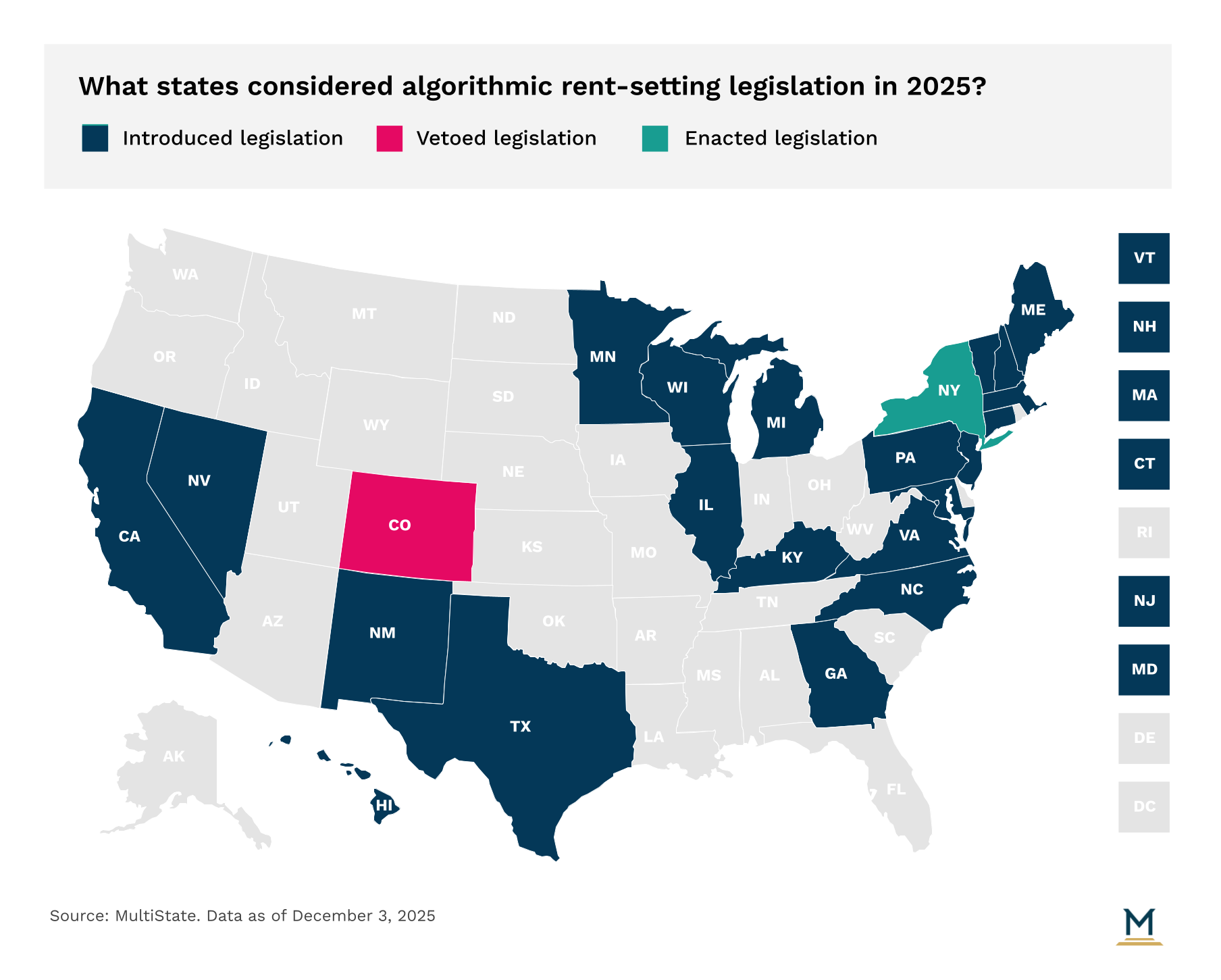
Beyond retail pricing, another form of algorithmic pricing has attracted significant regulatory attention: rent. Property managers in many markets have increasingly relied on software platforms that analyze real-time data on comparable units, local occupancy trends, and other factors to suggest or set rental prices. The most prominent of these tools, RealPage's YieldStar, gained national attention in 2022 when ProPublica reported that its widespread adoption among large landlords may have contributed to coordinated rent inflation in major U.S. cities. That reporting triggered a wave of investigations, lawsuits, and ultimately a Department of Justice lawsuit against RealPage filed in 2024 under the Biden administration, which remains pending under the Trump DOJ.
Several states have moved to address algorithmic rent-setting at the legislative level. Washington state was the first, enacting WA SB 5098 this year, which prohibits a landlord from using an algorithmic device to set or recommend the price of a residential rental unit if the device uses nonpublic competitor data. Oregon considered a similar proposal (OR HB 3062) that did not advance. Additional proposals are expected in 2026 as states track the federal litigation and look for ways to respond to the algorithmic rent-setting issue on their own terms.
Florida Proposes AI Bill of Rights for Consumer Protection
Florida Governor Ron DeSantis (R) recently proposed a set of principles he described as an "AI Bill of Rights," aimed at ensuring that individuals retain rights and protections when they interact with AI systems. While the specific legislative language has not yet been released, the governor's proposal generally mirrors the consumer-protection goals of the algorithmic discrimination bills we've covered, though it is framed with an emphasis on individual rights rather than mandates on companies.
Governor DeSantis framed the proposal as a direct response to what he described as the "unchecked power of big tech companies" and an effort to hold AI developers and deployers accountable when their systems cause real-world harm. The governor's announcement emphasized five core principles: (1) protection against algorithmic discrimination in employment, lending, and housing; (2) the right to human review of AI-driven decisions; (3) prohibition on deceptive AI impersonation; (4) prohibitions on exploitative AI targeting of children; and (5) protection of citizens from government-operated AI surveillance. These principles reflect a mix of concerns that have animated AI legislation across the country, but they have rarely been proposed together as a unified framework at the state level.
The announcement is notable because Florida is a large, Republican-led state where Gov. DeSantis has also opposed federal preemption of state AI laws. If legislation is introduced in the 2026 session based on these principles, it could signal a new lane for AI consumer protection legislation — one that avoids the "woke AI" framing associated with California-style regulation while still imposing real obligations on private-sector actors. This is one to watch as we head into next year's legislative sessions.
If you're a subscriber, click here for the full edition of this update. Or, click here to learn more about our MultiState.ai+ subscription.
If you’re a subscriber, click here for the full edition of this update. Or, click here to learn more about our MultiState.ai+ subscription.