
Key Takeaways
- States are taking a measured approach to AI workforce displacement legislation, with most proposals focused on studying AI's impact rather than imposing immediate restrictions or penalties.
- New Jersey's proposed AI Workforce Transition Act would require 90 days' notice before laying off 25 or more employees due to AI adoption and provide displaced workers with an additional 26 weeks of unemployment benefits.
- Several states are considering amendments to their WARN laws that would require employers to disclose when mass layoffs result from AI adoption, including details about the specific AI systems involved.
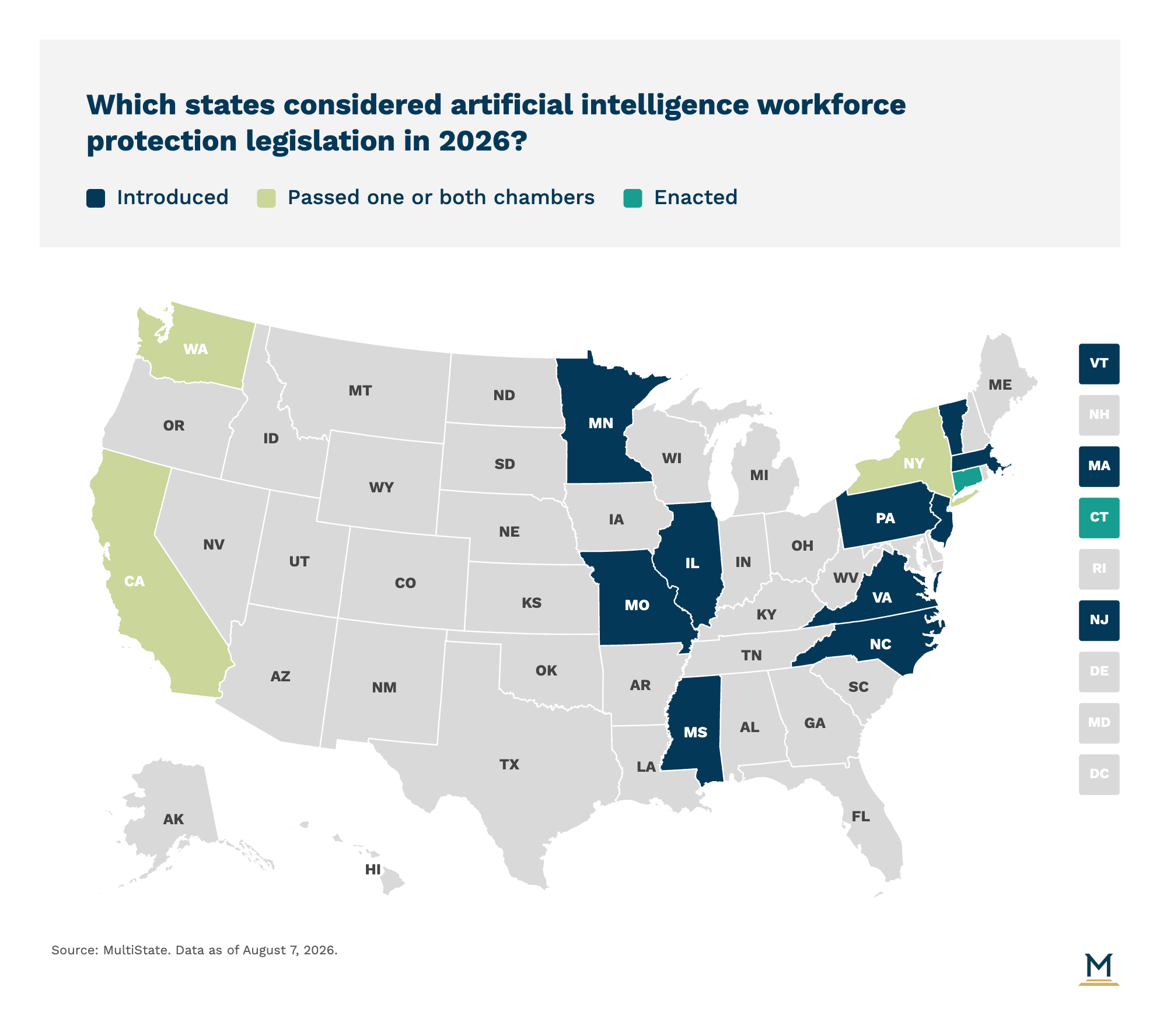
- Connecticut enacted legislation directing a comprehensive study of AI's impact on the state's workforce, including methods to track AI-related job displacement and scenario planning for various outcomes.
- Some states have proposed AI job displacement tax penalties on employers who replace workers with automation, though these proposals have struggled to gain legislative traction.
- If you're a subscriber, click here for the full edition of this update. Or, click here to learn more about our MultiState.ai+ subscription.
As companies and organizations continue to incorporate AI into their workflows, AI's impact on the workforce has been a topic of speculation among lawmakers and the public. While many AI tools aim to make work easier by automating time-consuming tasks and improving productivity, there is a growing concern that AI could displace workers. Despite this concern, states have been slow to enact AI workforce protection legislation, but have considered several proposals.
Some companies have announced layoffs due to the adoption of AI and research on its impact on the workforce is still emerging. A recent study found that some industries with high exposure to AI, such as finance and technology, had seen increased unemployment, as had younger workers. AI adoption is predicted to replace many repetitive and time-consuming tasks, something that is likely to save workers time; however, concerns have also been raised about job displacement in the job market due to AI adoption and automation.
WARN Act
The Worker Adjustment and Retraining Notification (WARN) Act is a federal law that requires employers with 100 or more employees to provide 60 days' advance notice of plant closings and mass layoffs. Many states have enacted their own versions of WARN laws, often with broader coverage or longer notice periods. Several states are now considering amendments to their WARN laws to require employers to disclose when mass layoffs result from AI adoption, including details about the specific AI systems or automation technologies involved.
Frequently Asked Questions
What states require employers to give notice when laying off workers due to AI?
New Jersey's proposed legislation (A 5316/S 4458) would require 90 days' notice when more than 25 employees will be laid off due to AI, with penalties up to $3,000 per affected employee. California (SB 951), Pennsylvania (HB 2669), Illinois (SB 3571), and Minnesota (HF 4369/SF 4576) are considering similar amendments to their WARN laws requiring disclosure when layoffs occur due to AI adoption. Minnesota's proposal would also entitle impacted employees to a 90-day transitional employment period with continued wages and access to retraining programs.
Are there tax penalties for companies that replace workers with AI?
New York considered legislation (A 3719) that would impose a tax on employers who displace employees due to AI adoption, and Mississippi considered legislation (HB 1810) that would impose a tax up to $10,000 for each position displaced due to AI for employers with more than 50 employees. Neither proposal gained significant traction this year. New Jersey's proposed legislation (A 5316/S 4458) takes a different approach by offering a human retention tax credit up to $750,000 for employers who maintain their worker headcount while deploying AI.
What is New York's AI workforce reporting requirement for businesses?
Legislation in New York (AB 9581/SB 8706) is currently awaiting Governor Kathy Hochul's signature and would direct businesses with more than 100 employees or that are publicly traded to annually report the impact AI has had on their hiring and business practices to the New York Department of Labor. The Department would then publish an annual report aggregating the data.
Which states are studying AI's impact on employment and the workforce?
Connecticut enacted legislation (SB 5) directing a study to develop a comprehensive strategy to address AI's impact on the state's workforce, including assessment of methods to track AI-related layoffs and the impact on entry-level employment. Illinois lawmakers considered several bills to study AI's workforce impact, including establishing a Future of Work Task Force (HB 4882), a Commission on Artificial Intelligence and Workforce Transition (HB 5760), and directing the Department of Commerce and Economic Opportunity to study AI's impact and propose worker protection recommendations (SB 2927).
Does New Jersey's AI workforce bill provide additional unemployment benefits for displaced workers?
Yes, New Jersey's proposed Artificial Intelligence Workforce Transition Act (A 5316/S 4458) would add an additional 26 weeks of unemployment insurance benefits for individuals who have been displaced by AI. The legislation also establishes an AI Displacement Account to fund workforce transition programs and requires 90 days' notice when more than 25 employees will be laid off due to AI.

