Key Takeaways
- 31 states have enacted laws regulating AI-generated election content, though some face constitutional challenges in court. These state political deepfake laws vary widely in their approach, with some requiring disclaimers while others prohibit deceptive content entirely.
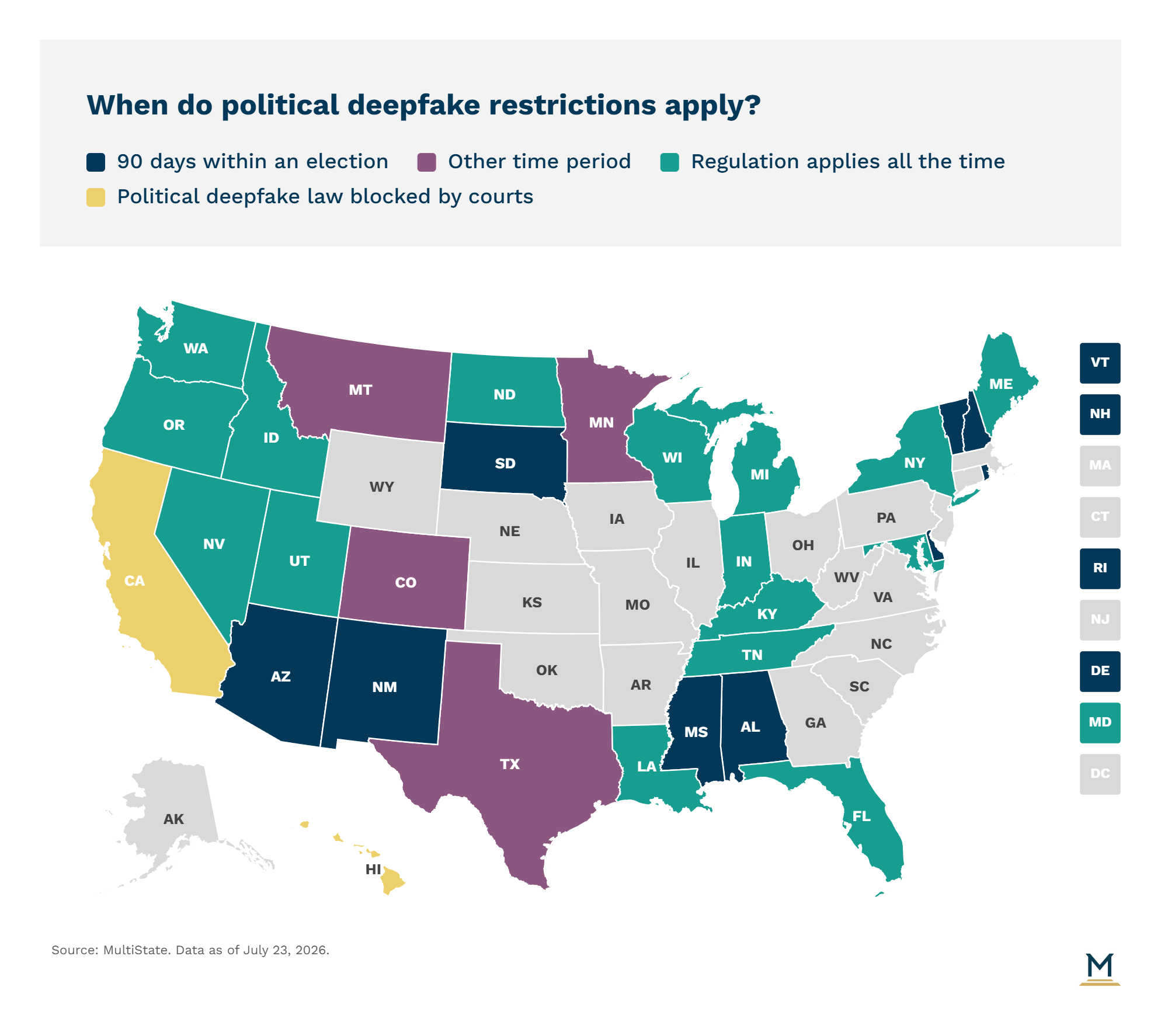
- Most states require disclaimers on AI-generated campaign materials only during a 90-day window before an election. Political deepfake disclaimer requirements range from prescriptive font sizes to simple disclosure statements, with Colorado mandating metadata documentation of the AI tools used.
- Courts have blocked enforcement of political deepfake laws in California and Hawaii, finding they likely violate First Amendment protections for political speech. These rulings highlight the tension between protecting election integrity and preserving constitutional rights to satire and parody.
- State AI election integrity laws typically exempt news organizations, platforms, and content that reasonable viewers would recognize as satire. Liability standards vary, with some states requiring proof of intent to deceive while others impose penalties when distributors knew or should have known content was fabricated.
- If you're a subscriber, click here for the full edition of this update. Or, click here to learn more about our MultiState.ai+ subscription.
As voters prepare to head to the polls this election season, lawmakers are grappling with a challenge that barely existed a few years ago - the proliferation of political deepfake content. Artificial intelligence allows anyone to create convincing, entirely fabricated images, audio, and video of candidates. This political cycle has already seen several political ads featuring AI-generated or modified content. Fearing that AI-generated deepfakes could mislead voters, suppress turnout, or undermine confidence in election results, states have moved quickly to enact new restrictions on deceptive campaign content. But some laws may run up against constitutional free speech rights, and may be more difficult to enforce than intended.
Political deepfakes were one of the first AI-related policy issues lawmakers tackled a few years back. Since 2019, states have enacted a growing number of laws regulating deceptive AI-generated election content, with legislative activity accelerating dramatically over the past two years. There are currently 31 states that have enacted political deepfake laws, although some have been held up by courts. These laws differ in whether or not they allow deepfake political content to air with disclaimers, when political ads are regulated or prohibited, and when parties are held liable.
Frequently Asked Questions
Which states completely ban political deepfakes even with disclaimers?
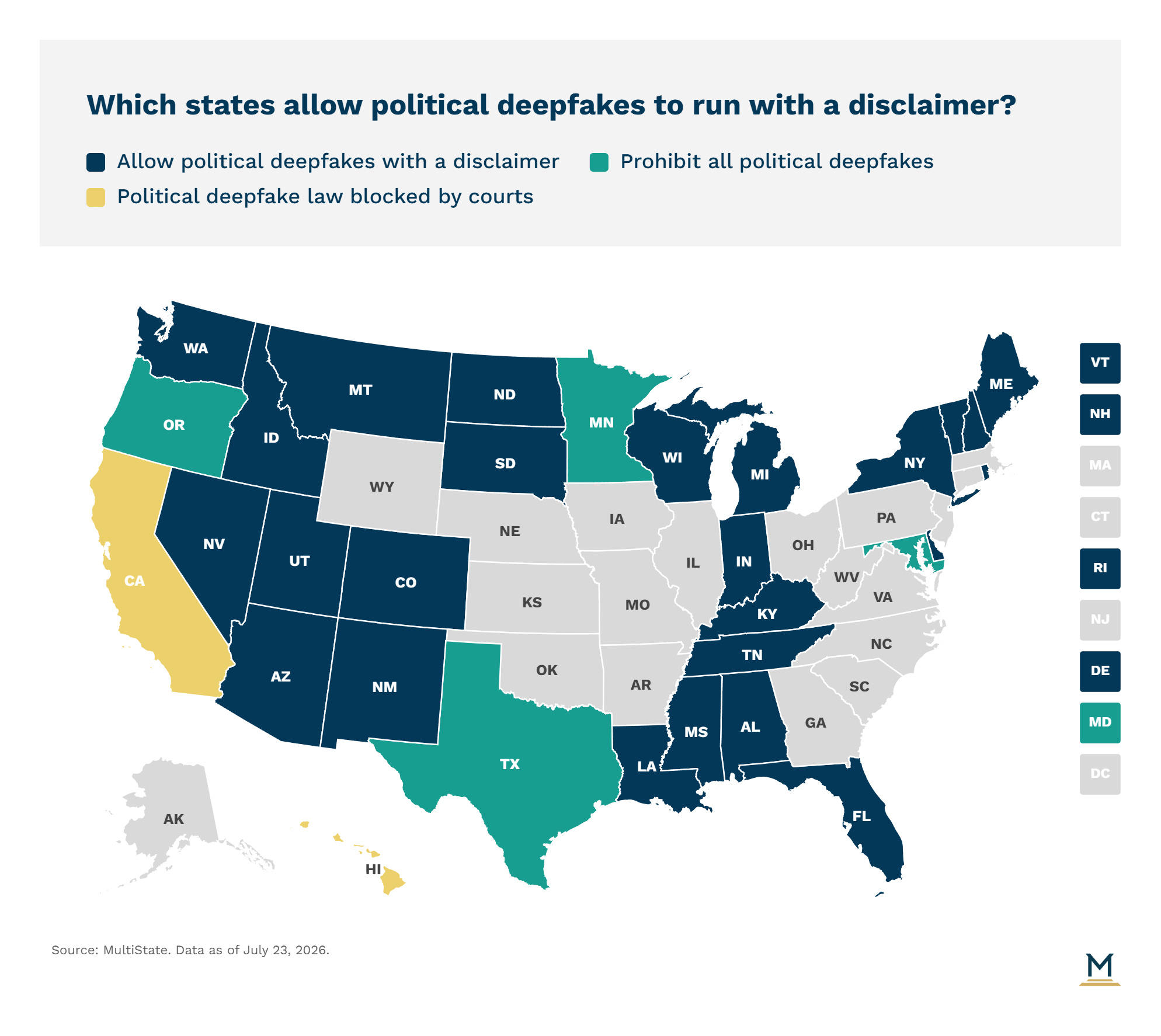
Maryland, Minnesota, Oregon, and Texas prohibit the distribution of deceptive political deepfakes regardless of whether a disclaimer is included. These states have determined that materially deceptive AI-generated election content poses sufficient harm to voters that transparency measures alone are inadequate.
What is the most common time window states use to regulate political deepfakes before an election?
Most states that have time-limited regulations apply their political deepfake laws during the 90 days before an election. Texas uses a shorter 30-day window, Montana applies a 60-day period for certain elections, and Colorado begins enforcement 60 days before primaries and 90 days before general elections.
Do state political deepfake laws apply to obvious satire or parody content?
Most state political deepfake laws are designed to exclude obvious parody and satire by requiring that the synthetic media be sufficiently realistic to convince a reasonable person that the depicted events actually occurred. Laws frequently include explicit exemptions for satirical content, which is protected under the First Amendment.
What happened to California's political deepfake laws AB 2839 and AB 2655?
A federal district court issued a preliminary injunction blocking much of California AB 2839 in 2024, finding it likely overbroad and impermissibly restrictive of protected political expression including satire. California AB 2655, which required social media platforms to block political deepfake content, was also blocked after a challenge by Elon Musk's X Corp.
What kind of disclaimer requirements do states impose on AI-generated political ads?
Disclaimer requirements vary significantly by state, with some prescribing exact language and font sizes while others provide general guidelines for disclosure statements. Colorado requires the metadata of the communication to include the disclosure statement, the identity of the tool used to create the deepfake, and the date and time the deepfake was created. Some states require the disclaimer as an affirmative defense whenever AI-generated or modified content is used, while others only require a disclaimer if the content is materially deceptive, substantially alters the content, is likely to deceive a reasonable person, and/or depicts something that never occurred.