
Key Takeaways
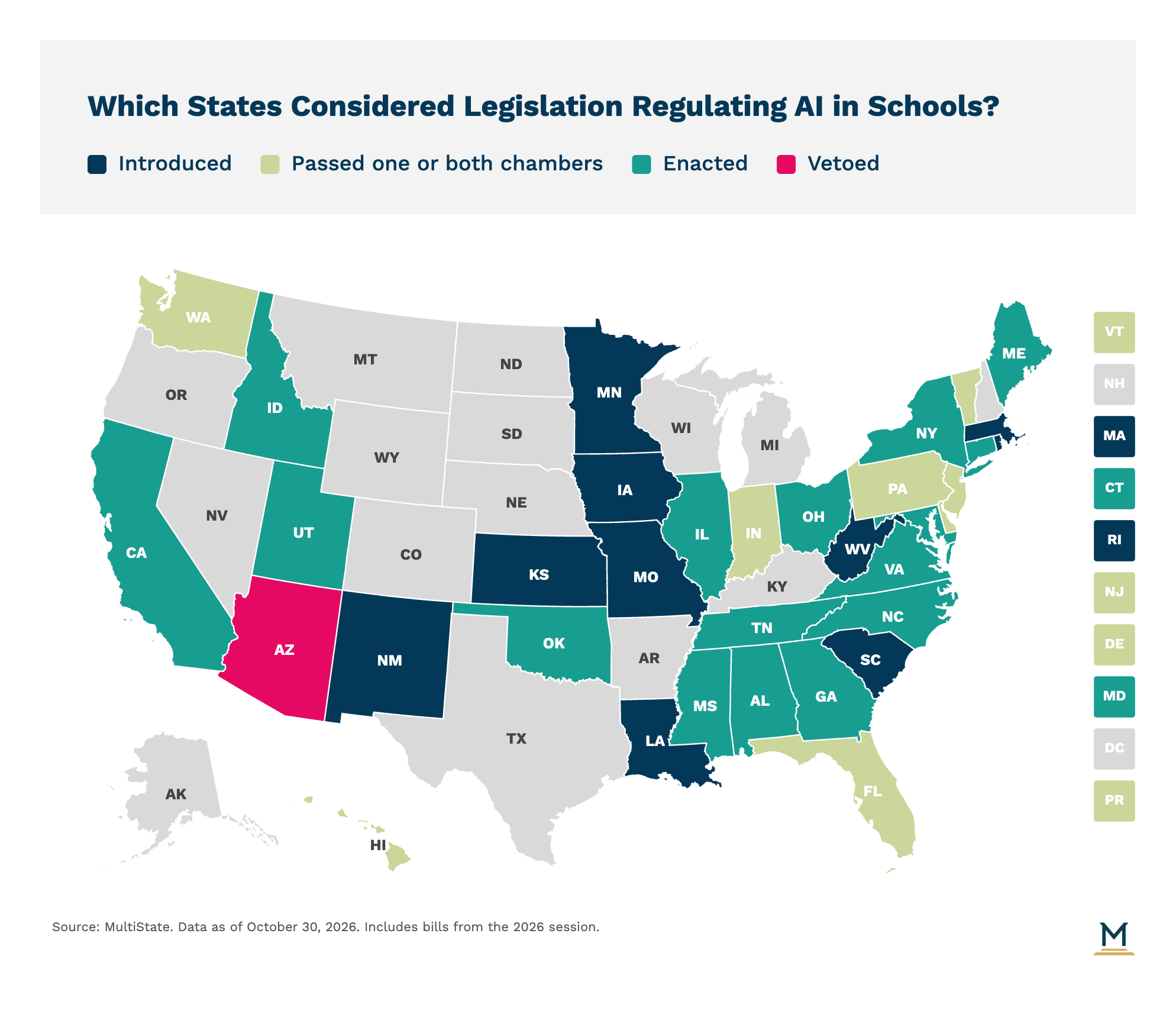
- Alabama expanded graduation requirements to include artificial intelligence through HB 329, while the state board of education updated digital literacy standards to incorporate AI and emerging technologies for implementation in the 2027-2028 school year.
- Connecticut passed SB 5 establishing the Connecticut AI Academy, an online education initiative that offers courses in AI literacy and prepares students for careers in artificial intelligence.
- Tennessee now requires teachers to complete at least one professional development course on AI use in the classroom by August 1, 2028, or within two years of becoming licensed under HB 545 and SB 677.
- Oklahoma passed SB 1734 directing the State Department of Education's Office of AI and Digital Learning to develop model policy guidance governing artificial intelligence and emerging technologies for school districts to adopt for the 2027-2028 school year.
- New York City Public Schools announced a one-year moratorium on student-facing generative AI for students in grades K-8 in September 2026, while Los Angeles Unified School District announced a districtwide ban on student use of generative AI on school devices.
- If you're a subscriber, click here for the full edition of this update. Or, click here to learn more about our MultiState.ai+ subscription.
Artificial intelligence creates both opportunities and challenges for schools, prompting state policymakers to decide how to use the technology in classrooms. With AI tools becoming more accessible to students and educators, states are working to balance the benefits of AI literacy and classroom integration with concerns about misuse and overreliance. In addition to passing legislation, state education agencies, education boards, and local school districts are developing guidance and policies to shape how schools use AI.
Teaching students how AI works and deciding when they should use it are separate questions for education policymakers. Efforts to build AI literacy can coexist with restrictions on classroom tools, as states and school districts weigh how to prepare students for emerging technologies while protecting the skills they need to develop on their own.
AI Literacy
AI literacy refers to the knowledge and skills needed to understand, use, and critically evaluate artificial intelligence technologies. It includes understanding how AI systems work, their capabilities and limitations, and their ethical implications. States are incorporating AI literacy into graduation requirements, academic standards, and educator preparation to ensure students can navigate AI tools responsibly and prepare for a workforce increasingly shaped by these technologies.
Frequently Asked Questions
Which states have passed legislation requiring AI literacy or AI-related graduation requirements for K-12 students?
Alabama passed legislation (HB 329) expanding graduation requirements in computer science to include the study of artificial intelligence. The Alabama State Board of Education also updated its digital literacy and computer science standards to include AI and emerging technologies, with implementation scheduled for the 2027-2028 school year.
What does Tennessee's law require teachers to do regarding AI professional development?
Tennessee requires teachers to complete at least one professional development course on AI use in the classroom by August 1, 2028, or within two years of becoming licensed, whichever is later. This requirement was established through HB 545/SB 677.
What are the largest school districts doing to restrict student use of generative AI?
New York City Public Schools announced a one-year moratorium on student-facing generative AI for students in grades K-8, while allowing limited use of approved tools in high school. The Los Angeles Unified School District announced a districtwide ban on student use of generative AI on school devices, and Chicago Public Schools abandoned plans to provide high school students with access to Google's Gemini chatbots through their school accounts.
Which states have directed their education agencies to develop AI policy guidance for school districts?
Oklahoma passed SB 1734 directing its State Department of Education's Office of AI and Digital Learning to develop model policy guidance for school districts to adopt for the 2027-2028 school year. Illinois passed SB 1920 directing its State Board of Education to develop statewide AI guidance for school districts and educators, and Ohio's appropriations bill (HB 96) requires school districts to adopt AI policies.
How much funding did North Carolina allocate for AI tutoring tools in schools, and what tool does it support?
North Carolina's education budget bill (SB 257) included $500,000 for schools to contract with Khan Academy for licenses to Khanmigo, an AI tutoring and teacher-support app for grades 6 through 12. The provision was scaled back from a proposed $10 million appropriation after educators and artificial intelligence experts raised questions about whether the program was properly evaluated.

