
Key Takeaways
- Democratic gains in last week's elections, including six new state government trifectas and a majority of governorships for the first time in 16 years, are likely to embolden lawmakers pursuing state AI legislation in 2027, including stronger safety standards and worker protections.
- Momentum for frontier AI safety laws is building, with Illinois SB 315 requiring annual independent audits of frontier models and lawmakers in California and New Mexico signaling plans to introduce similar oversight requirements next session.
- AI chatbot regulation states are expected to keep protecting children as a priority, building on the companion chatbot laws enacted by twelve states in 2026 and Minnesota's HF 1606, the first law banning "nudify" apps.
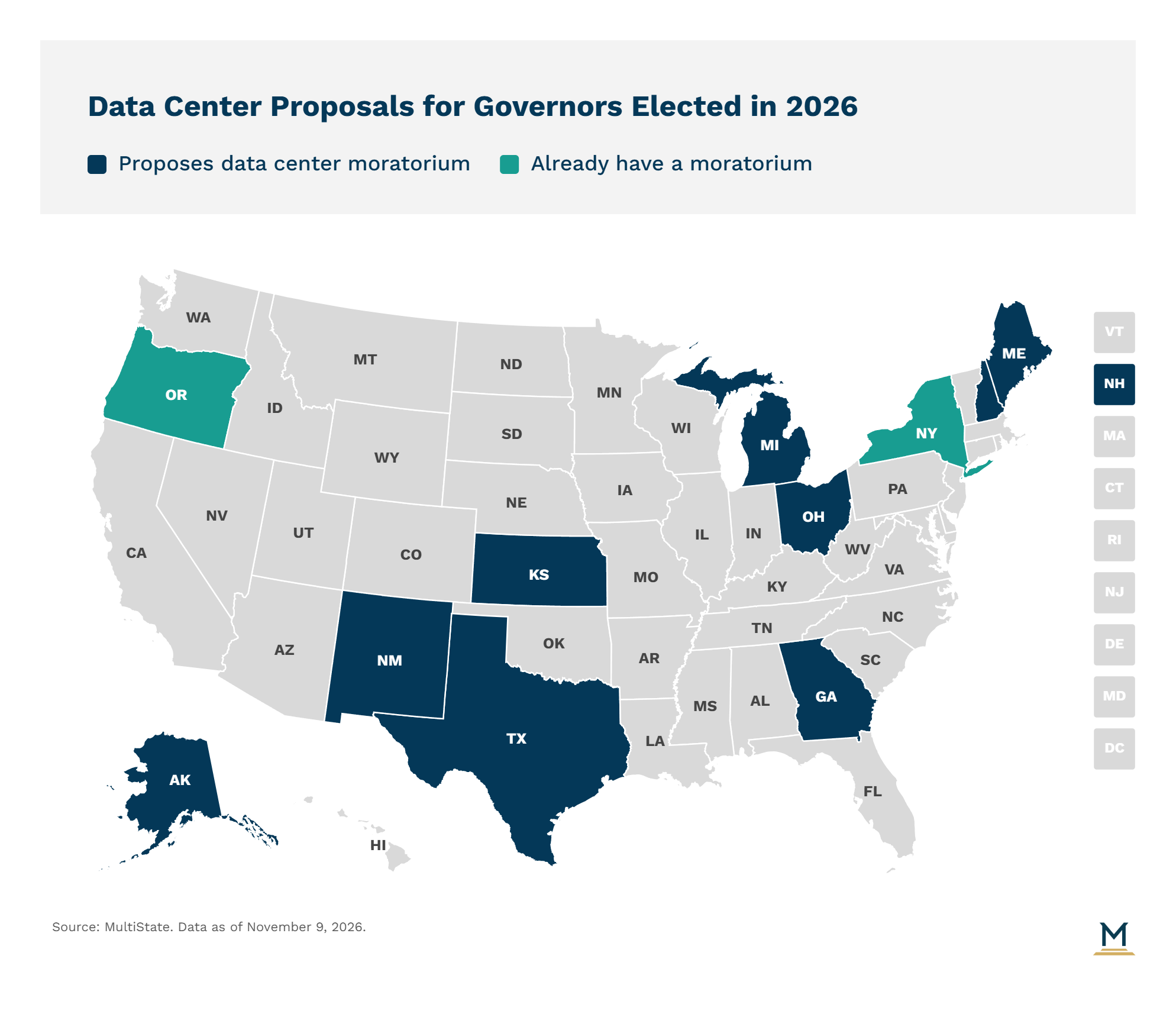
- Data center moratorium legislation is poised to gain traction after nine winning gubernatorial candidates campaigned on pausing data center development, reflecting voter concern over electricity bills, water use, and local control.
- Connecticut's SB 5 shows that states with existing AI laws aren't finished regulating, as Sen. James Maroney described the omnibus bill as "the floor" rather than a final word on AI oversight.
- If you're a subscriber, click here for the full edition of this update. Or, click here to learn more about our MultiState.ai+ subscription.
Last week's elections delivered a blue wave that could energize the debate over artificial intelligence and technology policy in state capitols next year. Voters expressed unease about the risks AI poses, the effects AI has on children, and the development of data centers needed to power the technology. While Democratic gains in Congress could increase the odds of federal legislation, many in the party treat federal standards more like a baseline that allows states to enact stricter regulations. Even if Washington moves toward national rules, states are likely to remain central to shaping how AI is developed and used.
Data Centers
Data centers are large facilities housing servers and networking equipment that store, process, and distribute data, including the computing infrastructure needed to train and run AI models. They require significant amounts of electricity and water for power and cooling, which has made their development a growing focus of state and local policy debates over utility costs, resource use, and community impact.
Frequently Asked Questions
Which states gained Democratic trifectas after the 2026 elections, and what AI legislation are they likely to pursue?
Arizona, Michigan, Minnesota, Nevada, Pennsylvania, and Wisconsin all gained Democratic trifectas. Michigan, Minnesota, Pennsylvania, and Wisconsin are industrial states where new Democratic majorities could propose legislation requiring notice before layoffs due to AI or regulations on the use of AI in employment settings.
What does Illinois SB 315 require, and how does it differ from AI laws in California and New York?
Illinois SB 315 requires annual independent audits of frontier AI models, going beyond similar laws in California and New York. The law represents frontier model regulation at the state level.
What AI child protection measures have states passed or are considering for 2027?
Twelve states passed companion chatbot laws in 2026 with additional protections for minors, and Minnesota passed HF 1606 banning "nudify" apps that allow users to generate nude images of real people through AI, though that law faces a court challenge. North Dakota lawmakers are set to consider bills that would prohibit AI intended to encourage self-harm or criminal activity and regulate companion chatbots, and lawmakers in Alabama, Oklahoma, South Carolina, and Tennessee have expressed interest in AI regulations to protect children.
What data center restrictions are states likely to pursue in 2027?
Nine gubernatorial candidates who won in the 2026 elections campaigned on imposing a moratorium on data center development. Many other successful gubernatorial candidates called for stronger regulations such as prohibiting non-disclosure agreements, paring back tax incentives, requiring disclosure of electricity and water usage, mitigating environmental and noise pollution, and requiring union labor in construction.
What does Connecticut SB 5 require, and is further AI legislation expected in Connecticut?
Connecticut SB 5 is an omnibus AI bill that passed in 2026. Following its passage, Connecticut Sen. James Maroney stated, "This is a start. This is not a finish; this is not a ceiling. This is the floor," signaling that additional AI legislation is expected.