
Florida's "AI Bill of Rights" Tackles Chatbots and Privacy
Weekly Update, Vol. 86.
Key Takeaways
Florida’s AI Bill of Rights proposes new requirements for chatbot disclosure, parental controls for companion chatbots, and civil penalties for violations, reflecting a proactive approach to Florida AI chatbot regulation.
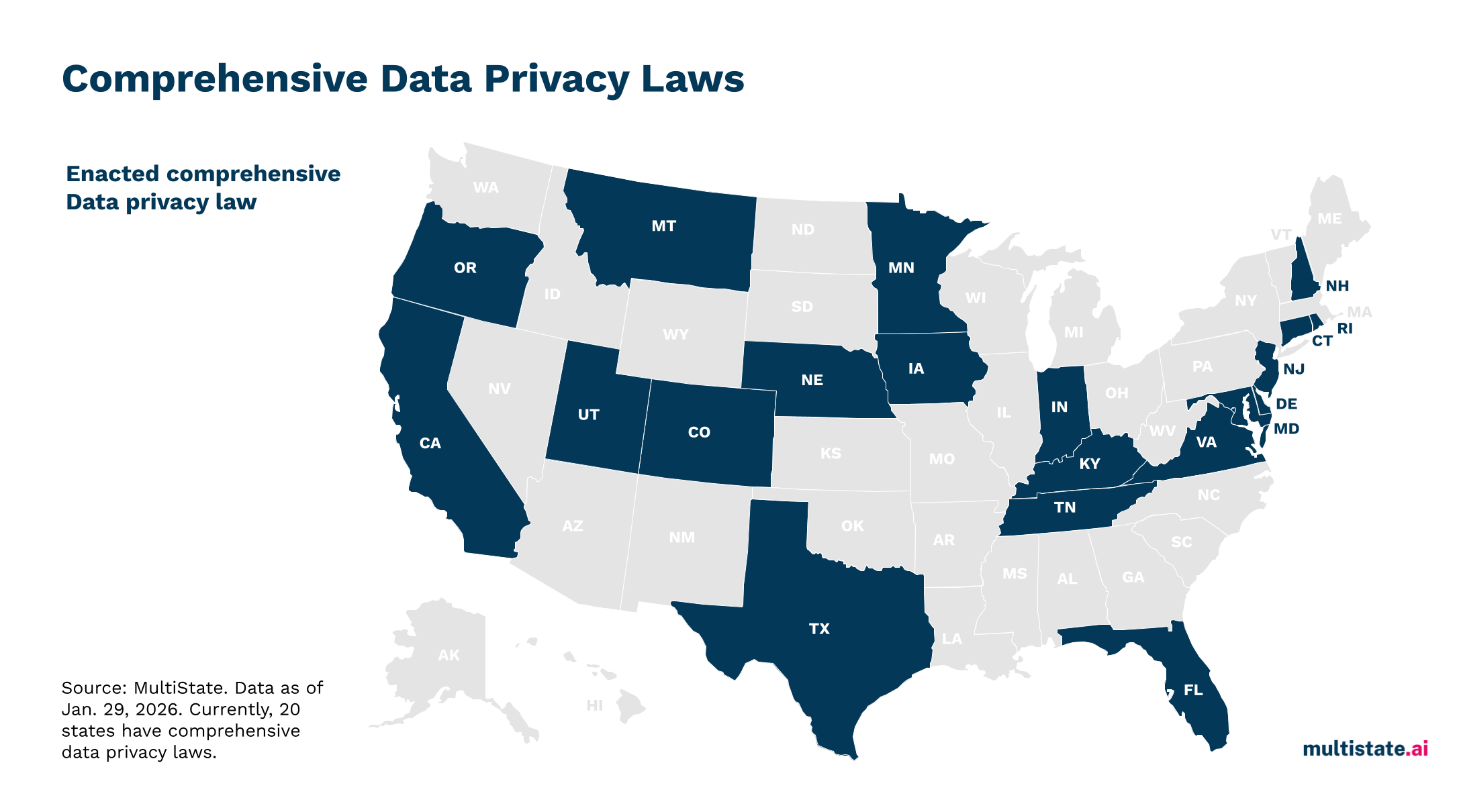
The legislation expands AI consumer privacy protections by restricting the sale or disclosure of personal data by companies using artificial intelligence, and uniquely allows individuals to sue under Florida’s deceptive and unfair trade practices law.
Provisions for digital likeness protection laws would prevent unauthorized commercial use of a person’s name, image, or likeness created by generative AI, aligning with recent trends in state-level regulation.
Florida’s approach signals a shift toward targeted state AI legislation in 2025, with other states like Connecticut, Oklahoma, and New York considering similar bills focused on specific AI risks rather than broad regulatory frameworks.
If you’re a subscriber, click here for the full edition of this update. Or, click here to learn more about our MultiState.ai+ subscription.
Last month, Florida Gov. Ron DeSantis proposed a wide-ranging “Artificial Intelligence Bill of Rights” that would regulate chatbots, AI data usage, and unauthorized digital likenesses. While President Trump and congressional Republicans have pushed for federal preemption to limit state AI regulation, Gov. DeSantis has bucked his own party by embracing an aggressive state-level role in setting guardrails for artificial intelligence. This session, Florida lawmakers have introduced bills that incorporate many of DeSantis’ proposals. This approach demonstrates an urgency to address potential risks of AI rather than waiting for a uniform federal framework to emerge.
Lawmakers have introduced versions of Florida’s AI Bill of Rights in each chamber (FL HB 1395/SB 482), with the Senate version already receiving committee approval. While the bills enumerate a series of “rights” Floridians are said to possess when interacting with AI, the rights are only “in accordance with existing law” and are not to be “construed as creating new or independent rights or entitlements.”
Instead, the meat of the legislation is in specified use-case regulations of artificial intelligence that can be divided into three categories: chatbots, consumer privacy protections, and digitally created content.
If you’re a subscriber, click here for the full edition of this update. Or, click here to learn more about our MultiState.ai+ subscription.

