Key Takeaways
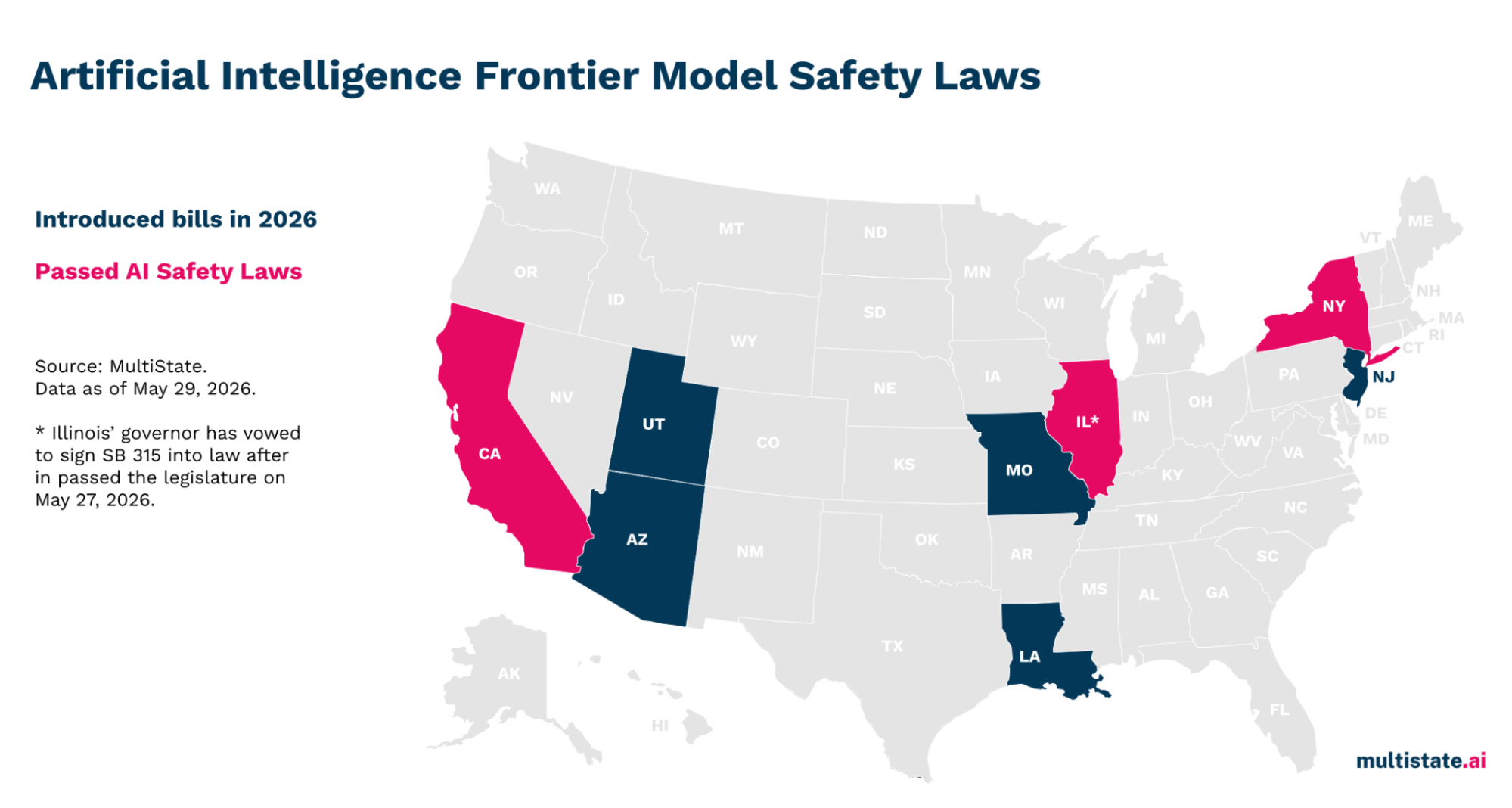
Illinois passed a major AI safety bill that, once signed by Governor Pritzker, will make it the third state to enact frontier AI safety legislation, joining California and New York in requiring transparency and safety reporting from the most advanced AI model developers.
The three state laws share nearly identical definitions, requirements, and enforcement mechanisms, and OpenAI has endorsed this emerging framework as the foundation for a de facto national standard it calls "reverse federalism."
Illinois SB 315 goes further than the California and New York laws by adding a mandatory independent third-party audit requirement for large frontier developers, a provision that advocates had pushed for but that didn't survive in either of the earlier laws.
All three laws focus narrowly on frontier AI models and the most severe potential harms, including assistance with weapons of mass destruction and cyberattacks, and enforcement falls exclusively to each state's attorney general with no private right of action.
Most of Illinois SB 315 takes effect on January 1, 2027, but the third-party audit requirement doesn't kick in until 2028, giving the AI safety community roughly a year and a half to build out the auditing expertise and infrastructure the law will require.
If you're a subscriber, click here for the full edition of this update. Or, click here to learn more about our MultiState.ai+ subscription.
On Wednesday, Illinois lawmakers overwhelmingly passed a major AI safety bill (IL SB 315) and sent it to the governor for his expected signature, a move that would make Illinois the third state to enact such a law. After California enacted Sen. Scott Wiener's (D) frontier AI safety law last year, and New York aligned Assemblymember Alex Bores' (D) bill with the California law a few months later, the AI safety community seemed poised to take a year off from big political battles and focus on implementing California's law, which took effect last January. But the late-session developments in Illinois did more than add the attorney general of a third major blue state to those keeping a close eye on frontier AI developers. They also produced a third-party auditing requirement that had eluded advocates of the earlier laws. And it didn't hurt that a key voice in the debate had a sudden change of heart, explicitly backing the effort in Illinois.
Unlike the vast majority of the thousands of AI-related bills we track at the state level, "AI Safety" legislation is a small but important subset — only a handful of bills each session — focused on the catastrophic harms powerful AI models could cause on their own or help humans inflict, such as chemical, biological, radiological, or nuclear (CBRN) weapons or major cybersecurity attacks. AI Safety bills are narrowly targeted to apply to the most advanced "frontier" AI models. And at this point, these laws largely accomplish this goal through transparency requirements and safety test reporting.
If you're a subscriber, click here for the full edition of this update. Or, click here to learn more about our MultiState.ai+ subscription.