
Trends in State AI Companion Chatbot Laws (Crisis Intervention, Minor Safety, and More)
Key Takeaways
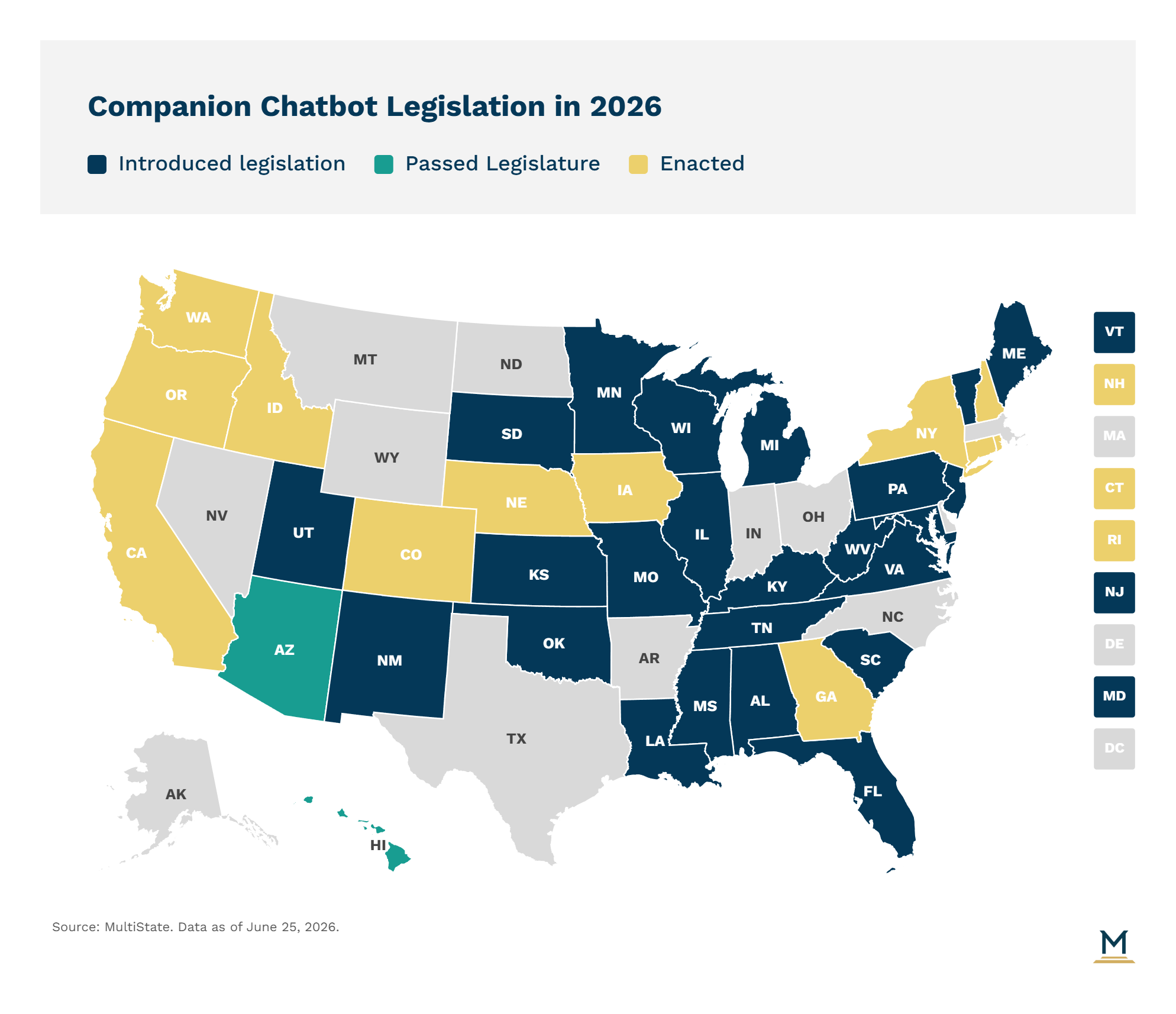
- Twelve states have enacted companion chatbot regulation in 2026, establishing a growing consensus on how to address the unique risks posed by AI systems designed to build emotional relationships with users.
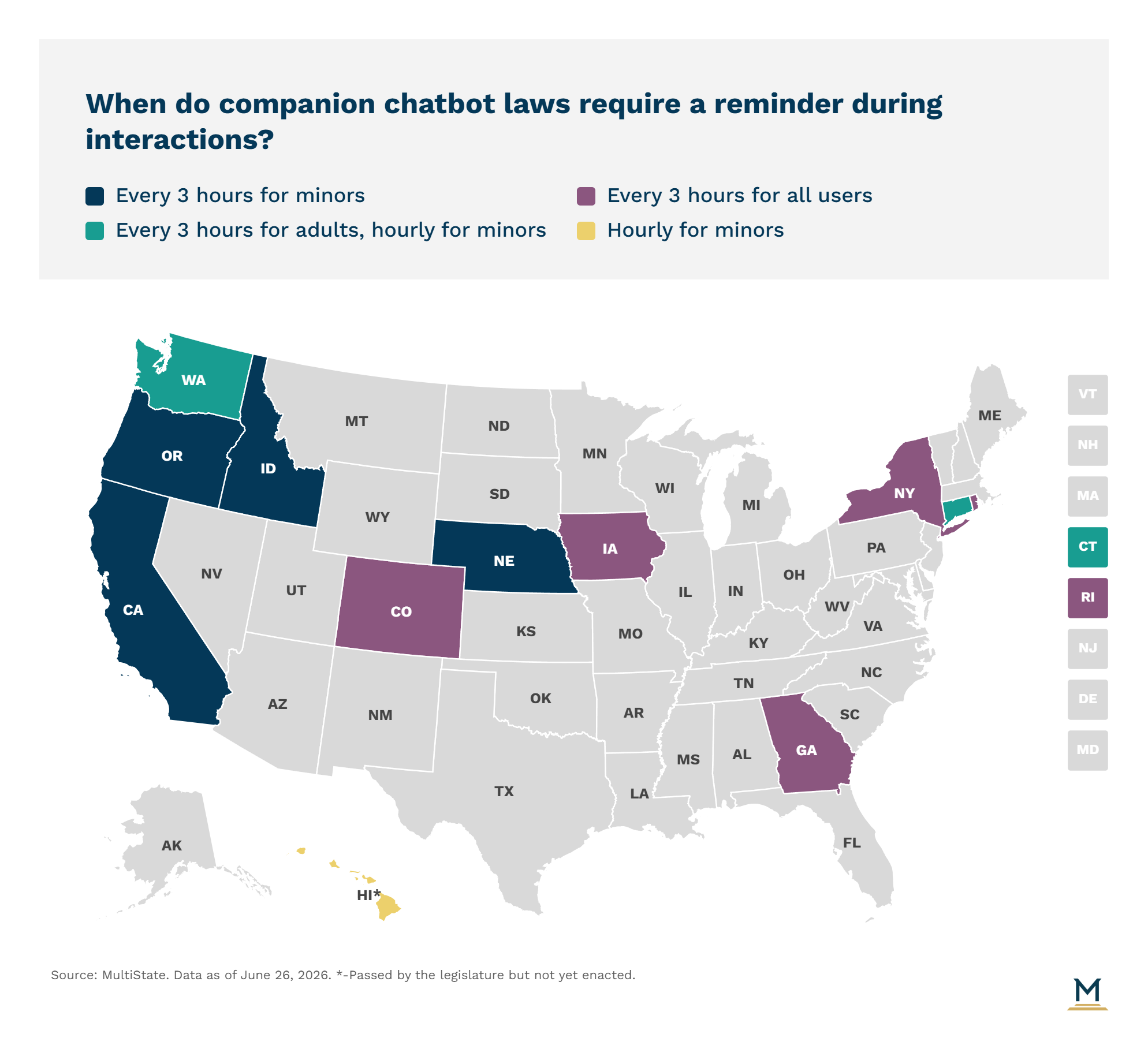
- All enacted state AI companion chatbot laws require disclosure reminders that users are interacting with AI rather than a human, with some states requiring these reminders every three hours for all users and others applying hourly reminders specifically for minors.
- AI chatbot crisis intervention requirements now mandate that operators implement protocols to recognize expressions of suicidal ideation or self-harm and direct users to resources like the 988 Suicide & Crisis Lifeline.
- Enhanced protections for minors in companion chatbot regulation prohibit sexually explicit content, romantic interactions, emotional manipulation, and addictive engagement techniques, though states differ on whether age verification is required to trigger these safeguards.
- State artificial intelligence legislation in 2026 reflects a laboratory approach to AI regulation, with companion chatbot laws emerging as one area where states are developing similar frameworks even as comprehensive federal legislation remains stalled.
- If you're a subscriber, click here for the full edition of this update. Or, click here to learn more about our MultiState.ai+ subscription.
Much of the debate over artificial intelligence regulation has centered on the prospect of a patchwork of state laws. Critics of state-level rules have argued that differing state requirements could create compliance challenges and have instead urged Congress to adopt a single national framework. While comprehensive federal AI legislation remains elusive, states may be moving toward a consensus on their own. This year, several states have enacted similar laws regulating companion chatbots, reflecting a growing agreement on the unique risks posed by AI systems designed to build ongoing emotional relationships with users, particularly minors.
AI companion chatbots, or "conversational AI systems," have quickly become one of the most closely watched issues in state AI policymaking. As these systems have become more sophisticated, lawmakers have responded with a growing wave of bills aimed at limiting their most concerning features. Through the first half of 2026, twelve states have enacted companion chatbot laws, while a bill in Hawaii (HI SB 3001) has been sent to Gov. Josh Green (D) for his signature, and Gov. Katie Hobbs (D) vetoed a companion chatbot bill (AZ HB 2311) in Arizona last week.
Defining Key Terms
Companion Chatbot (Conversational AI System)
An AI system designed to simulate an ongoing human-like relationship by engaging in natural conversation, remembering prior interactions and user preferences, and maintaining continuing discussions about a user's personal life or emotional well-being. These systems are distinguished from conventional chatbots by their ability to proactively ask emotion-based or unsolicited personal questions that foster ongoing engagement.
Age Assurance
A method or technology used to verify or estimate a user's age before granting access to age-restricted content or features. Age assurance can include age verification (confirming exact age through documents) or age estimation (using commercially reasonable methods to approximate age range).
Anthropomorphic Deception
The phenomenon where users attribute human-like qualities, emotions, or consciousness to AI systems that mimic conversation, empathy, and emotional engagement, potentially causing users to forget they are interacting with software rather than a human being.
Crisis Intervention Protocol
A set of procedures that AI companion chatbot operators must implement to recognize user expressions of suicidal ideation, self-harm, or other crisis situations and direct users to appropriate mental health resources such as the 988 Suicide & Crisis Lifeline.
Frequently Asked Questions
Which states have passed laws regulating AI companion chatbots in 2026?
Twelve states have enacted companion chatbot laws through the first half of 2026: Colorado, Georgia, Iowa, New York, Rhode Island, California, Idaho, Nebraska, Oregon, Connecticut, and Washington. Hawaii has sent a companion chatbot bill (SB 3001) to the governor for signature, while Arizona's governor vetoed a similar bill (HB 2311) last week.
What are the main requirements in state AI companion chatbot laws for minors?
Most states require operators to take reasonable measures to prevent companion chatbots from engaging in certain interactions or generating certain content for minors, such as sexually explicit content, romantic or sexual interactions, emotional dependency and manipulation, claims of being human or sentient, and encouraging self-harm or suicide. States differ on implementation—some require age assurance or estimation measures before applying minor-specific safeguards, others apply restrictions when operators know or should reasonably believe a user is a minor, and some apply restrictions to all users to avoid age verification.
Do companion chatbot laws require crisis intervention for suicidal users?
All twelve enacted companion chatbot laws require operators to implement protocols for responding to user expressions of suicidal ideation or self-harm by making reasonable efforts to refer users to crisis resources like the 988 Suicide & Crisis Lifeline. Connecticut and Rhode Island expand these requirements to cover expressions of harm to others or imminent violence, while Georgia and Washington include eating disorder-related self-harm in their protocols.
How often do state laws require AI companion chatbots to remind users they're talking to AI?
Reminder frequency varies by state. Colorado, Georgia, Iowa, New York, and Rhode Island require reminders once every three hours for all users, while California, Idaho, Nebraska, and Oregon require three-hour reminders only for minors. Connecticut and Washington require three-hour reminders for adults but hourly reminders for minors.
How do state laws define what qualifies as a companion chatbot versus a regular chatbot?
Enacted laws generally define companion chatbots as AI systems designed to simulate an ongoing human-like relationship by engaging in natural conversation, remembering prior interactions and user preferences, and maintaining continuing discussions about a user's personal life or emotional well-being. Several states further distinguish companion chatbots from conventional chatbots by requiring that they proactively ask emotion-based or unsolicited personal questions. Most laws specifically exempt AI systems whose primary purpose is not companionship, including customer service and commerce tools, business productivity and research applications, internal enterprise systems, developer tools, virtual assistants, and AI features embedded in video games or other software.